

Rising rates of depression and suicide among adolescents have pushed states to explore new approaches to school-based mental health support. This post examines New Jersey’s universal mental health screening initiative, drawing on evidence from large-scale efforts in Pennsylvania and policy lessons emerging from Illinois.
We are living in the midst of a youth mental health crisis, with current epidemiological research painting a worrying picture. Just two years ago, nearly 40% of high school students reported symptoms of depression. This statistic becomes even more troubling when we consider that suicide rates amongst teens and pre-teens have seen a sharp 85.3% increase in just a ten-year period from 2007 to 2017 (Woolf et al., 2025).
Policymakers and education experts in New Jersey have responded to this crisis in a number of ways, with mental health screening in schools playing a major role. More specifically, in 2021 the Mental Health Screening in Schools Grant Program was created, allocating funding to support 11 pilot districts. Selected school districts would establish universal depression screening for secondary students as part of this program beginning in 2024 (Blitz et al., 2025).
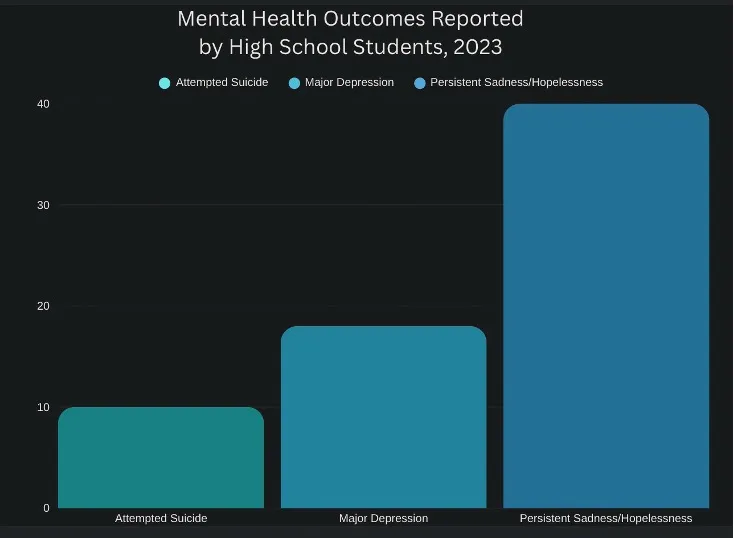
In assessing the viability of New Jersey’s approach, it might be helpful to review other cases where similar procedures have been implemented. The cases of mental health screening in neighboring Pennsylvania and Illinois provide illustrative examples. This is not only because of the large scale of screening carried out in these contexts, but also due to available data on the effectiveness of those programs in identifying and referring at-risk students.
Pennsylvania: Charting Real-World Outcomes
In a randomized three-year clinical trial studying outcomes in participating Pennsylvania schools, researchers found compelling evidence for the effectiveness of universal mental health screening. Over 12,000 students from 14 high schools were involved in this study, with students in two grade levels randomly assigned to screening procedures.
Students in the group that underwent universal screening were 5.9 times more likely to be identified with symptoms of Major Depressive Disorder (Sekhar et al., 2021). Identification is of course a crucial step to treatment. Indeed the study found that students in the screened group also had several times higher odds of beginning recommended treatment for depression after being identified.
Results of the study also shed light on how screening programs can serve students from a wide range of backgrounds. Higher rates of identification were found amongst both female students and students belonging to minority groups (Sekhar et al., 2021). This suggests public schools as a site for universal screening can help eliminate obstacles faced by students due to gendered or other demographic differences.
Illinois: What do the Schools Say?
Illinois presents another example where we see large-scale instances of mental health screening in schools. The state experimented with these initiatives for years before formally passing bill SB-1560 in 2025, which would require all school districts to provide universal mental health screening. Whilst there is no data yet on outcomes as schools are not required to offer screening until the start of the 2027-2028 school year, there is research on the views of both school professionals and students regarding the topic.
In 2023, the Illinois Board of Education conducted a landscape scan studying attitudes on the current mental health screening practices of school districts. In listening sessions conducted by the Board, school practitioners made clear the magnitude of the crisis. For instance, one administrator reported that one in five students at their school had suicidal ideation within the past year. This view was reinforced by students themselves. A consistent message from students was that they felt it was critical they and their classmates received crucial mental health care (Illinois State Board of Education, 2023).
Another important theme emerging from these listening sessions was that many participants supported screening in a universal context specifically. Universal screening was contrasted with a more selective screening program, which one mental health coordinator believed would only identify students with “externalizing behavior” (Illinois State Board of Education, 2023). Students with more internalized symptoms may be left behind with such approaches, whereas universal screening allows school mental health professionals to take the initiative and remain proactive according to practitioners.
Students agreed with school professionals on this topic as well. Those who were interviewed pointed out that their schools often used academic performance as a metric for mental health. This led many students to believe some of their peers struggling with mental health issues might go unnoticed on account of high academic performance, an issue that can be easily addressed with a more universal approach.
Practitioners in Illinois also offered important feedback on what implementation would require. Capacity support for staff was regularly emphasized as crucial to ensuring the success of any universal mental health screening program. Another key element of screening programs would have to be the collection and analysis of useful data. Participants believed analyzing the results of screening could inform future programs, discussions on budgeting, and other considerations (Illinois State Board of Education, 2023).
Finally, feedback also recommended policy support that would target parents in order to make implementation easier. Communication with parents to ensure support was a key initiative brought up by practitioners. Another cited method of engagement were wider education campaigns that would target not just parents but the larger community. School mental health professionals believed this to be a viable method of reducing stigma around mental health screening and conveying information on the severity of the youth mental health crisis. Outreach programs such as these also allow for important feedback that can further inform screening efforts in the future.
A Road Forward: From Crisis to Action
Taken together, the experiences of mental health screening in Pennsylvania and Illinois schools offer valuable insights for practitioners and policymakers in New Jersey. Evidence from Pennsylvania demonstrates that screening can dramatically improve the identification and treatment of depression across diverse student populations, while stakeholder feedback in Illinois highlights the kinds of practical supports (data collection, staff capacity, and community engagement) needed to ensure that these programs succeed.
New Jersey’s pilot districts stand at a crucial moment. The state has recognized the urgency of the youth mental health crisis and invested in a proactive strategy, but the effectiveness of this approach will depend on implementation and ongoing evaluation. By learning from similar initiatives in other states, New Jersey has the opportunity to deliver the mental health support all students deserve.
______
References
Andersen, R., Holm, A., & Côté, J. E. (2021). The student mental health crisis: Assessing psychiatric and developmental explanatory models. Journal of adolescence, 86, 101-114.
Blitz, C., Amiel, D., Yanovitzky, I. (2025). A Mixed-Methods Investigation of School Readiness to Implement Universal Adolescent Depression Screenings: The Case in New Jersey [In press]. Graduate School of Education, Rutgers University.
Briesch, A. M., Chafouleas, S. M., & Chaffee, R. K. (2018). Analysis of state-level guidance regarding school-based, universal screening for social, emotional, and behavioral risk. School Mental Health, 10(2), 147-162.
Illinois State Board of Education. (2023, December 15). Lessons learned: A landscape scan of mental health screening practices in Illinois schools (Public Act 103-0546) [Report]. https://www.isbe.net/Documents/Lessons-Learned-Landscape-Scan-Mental-Health-Screening-IL-Schools.pdf
Sekhar, D. L., Schaefer, E. W., Waxmonsky, J. G., Walker-Harding, L. R., Pattison, K. L., Molinari, A., … & Kraschnewski, J. L. (2021). Screening in high schools to identify, evaluate, and lower depression among adolescents: a randomized clinical trial. JAMA network open, 4(11), e2131836-e2131836.
Woolf, S. H. (2025). The Youth Mental Health Crisis in the United States: Epidemiology, Contributors, and Potential Solutions. Pediatrics, 156(5), e2025070849.