Rutgers CESP and a participant from the Rutgers EIR project shared two key resources at the premier CS education conference: an engaging Scratch programming project that has students create arcade-style games, and a tool that helps educators evaluate and select middle school computer science curricula.
By Anna Lasek, Communications Assistant at Rutgers CESP
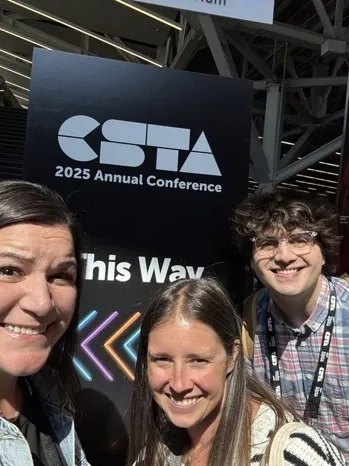
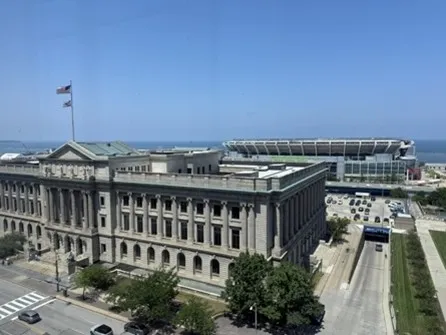
Last week, CESP’s David Amiel and two teachers from Roselle Park participating in the Extending the CS Pipeline project attended the 2025 Computer Science Teachers Association (CSTA) Annual Conference. This premier gathering brings together educators, researchers, and advocates to share innovative ideas for advancing computer science education.
Rutgers CESP has been actively contributing to CS education for many years through projects like the NSF-funded CS-TLC RPP initiative and the ongoing USDOE EIR project. At this year’s CSTA conference, CESP presented two sessions that highlighted their latest work: a poster presentation on the Scratch Arcade project and a session on curriculum selection strategies featuring the CS Curriculum Crosswalk tool.
The Scratch Arcade: Engaging Middle School Students Through Game Design
The Scratch Arcade—a collaborative project developed in partnership with teacher Kristen Hickman (and 2023 County Teacher of the Year) from the Roselle Park School District, is designed to introduce students to Scratch Programming through an interactive, multi-stage design project. In a few weeks, students develop essential programming skills, implement them in Scratch, develop their own arcade-style game, give and use constructive peer feedback, and host a class arcade day!
Structured over 12 class sessions, the project emphasizes:
- Core CS concepts like loops, conditionals, variables, and debugging
- Engagement through peer feedback, collaborative programming, and a culminating game fair
- Cross-curricular connections to art, math, and ELA
- Flexible scaffolds to support different learning types
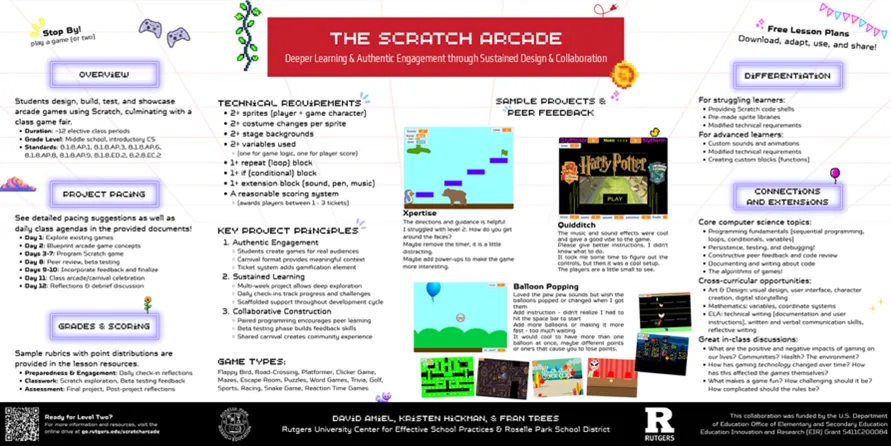
Through this project, students learn not only the process of coding, but also explore “real-life” programming (sustained attention on the same project, peer feedback, etc.). The project opens the doors to many great class discussions, such as the impacts of gaming on society and our well-being, ethics and ownership of technology, and game design! The Scratch Arcade can be adapted broadly across grade levels and include many ways to scaffold and differentiate materials and requirements for a variety of learners.
Explore the free Scratch Arcade lesson materials here: go.rutgers.edu/scratcharcade
Curriculum Considerations: Making Informed, Equitable Decisions
In CESP’s presentation at CSTA, David Amiel aimed to help educators explore computer science curricular resources and methods. Our presentation offered a three-phase process for the use of curricular resources: locating, evaluating, and adapting. Although this process is obvious, breaking down this commonplace task systematically gives us a framework to discuss and optimize each of the pieces (hey, we’re using our computational thinking!). This encourages educators to make equitable and purposeful decisions about the topics they teach, and the ways they approach it. This presentation focused on the evaluating phase and invited educators to consider resources’ content, context, and logistics.
The presentation also discussed the Middle School CS Curriculum Crosswalk, a free online tool that compares eight popular middle school CS programs across content, context, and various dimensions of execution. Whether you’re looking to replace an entire course, add a project, or supplement a lesson, this resource helps you choose the right fit for your students and setting. In addition to compiling logistic information about curricula in one place, the Crosswalk also includes contextual and informed guidance, such as spotlights, expert takes, and implementation considerations.
When considering a lesson:
- Start with a specific instructional need. Approach topics and lessons with purpose so that students walk away with concrete knowledge and understanding of various topics.
- Use relevance and feasibility factors (e.g., standards, materials needed, lesson duration) to guide your review
- Adapt—don’t adopt—resources; make them your own and do your best to reach multiple learning types.
Access the CS Crosswalk here: go.rutgers.edu/CSCrosswalk
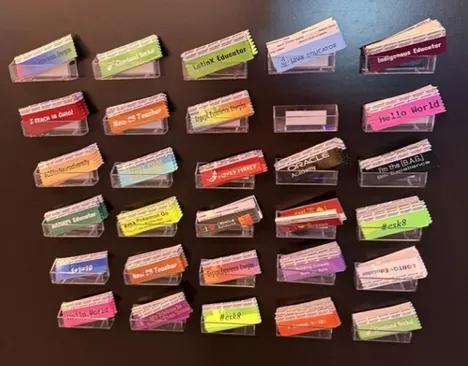
From tools that empower curricular choices to projects that center student creativity, connecting with other educators, learning from their expertise, and sharing our own at CSTA 2025 reaffirmed CESP’s commitment to engaging computer science education. We’re grateful for the conversations, connections, and shared vision of what CS education can be, and a special shout-out to our co-presenter Kristen Hickman from Roselle Park!